Sales and marketing funnel — what are they and how to use boards to plan them effectively?
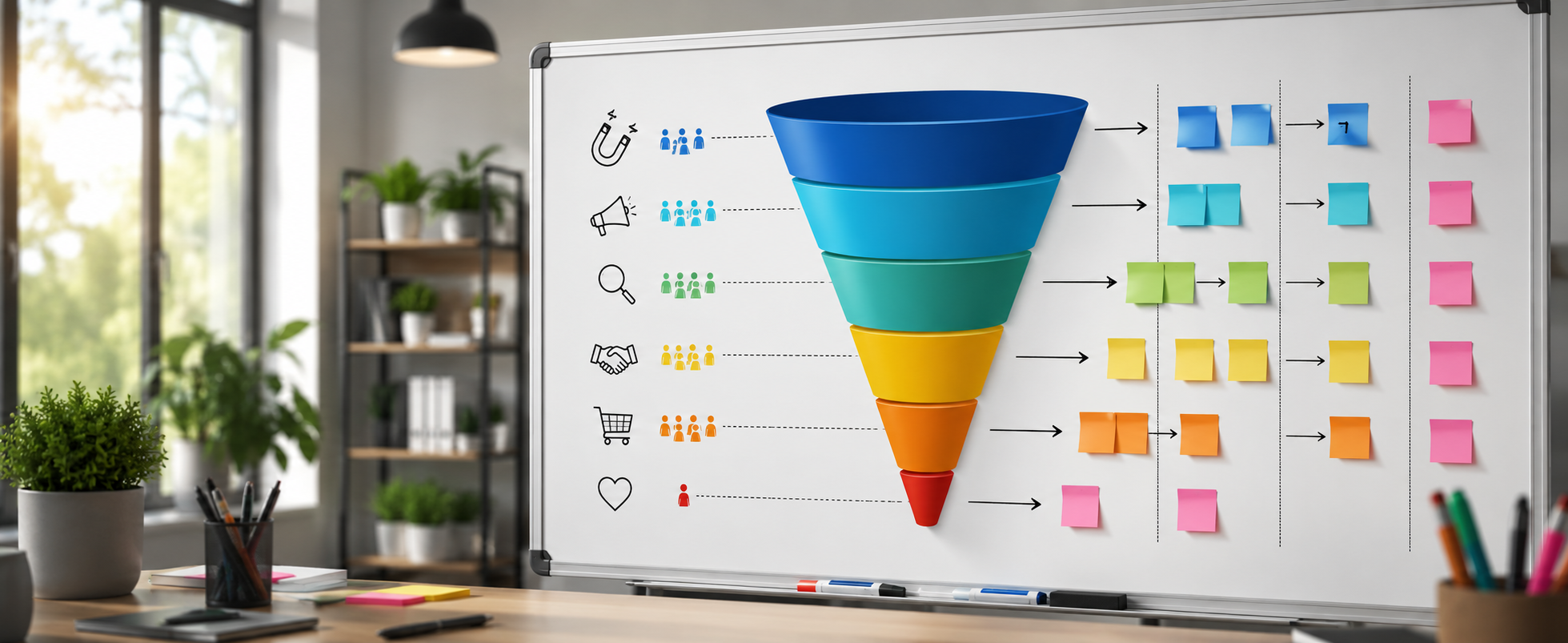
Do you want to increase sales and organise your commercial activities? Discover a tool that helps you understand the customer journey to purchase. Learn how to combine it with boards to visualise progress and achieve better results!
In this article you will learn:
- what a sales funnel is and what stages it includes,
- how visualization can help increase sales,
- how to use magnetic, dry-erase, cork and chalk boards to plan and track progress.
What is a sales funnel?
A sales funnel is a model that illustrates the path of a potential customer from the first contact with a brand to the final purchase. It resembles an inverted triangle — at the top there are many people who are just discovering your offer, and at the bottom those who actually make a purchase.
It is also worth mentioning the marketing funnel — a part of the sales funnel that focuses on activities designed to attract attention and build interest in the offer before the purchase decision is made.
Well-designed sales funnels help not only to visualize the process but also measure the effectiveness of marketing and sales activities at every stage of the customer journey.
Example: a customer sees an advertisement for a product — for example a whiteboard— and visits the website. They browse the offer, compare it with competitors, add the product to the cart and complete the purchase. Each of these actions represents a stage of the sales funnel that should be analysed to optimize the sales process and build long-term customer relationships.
Sales funnel stages – from awareness to purchase
- Awareness – the customer encounters your brand for the first time, for example through a social media advertisement.
- Interest – they start searching for more information, visit your website and explore the product.
- Consideration – they compare offers, read reviews and analyse which product better meets their needs.
- Decision – they choose a specific option.
- Purchase – the transaction is finalized.
Each of these stages should be measured using KPI indicators, such as the number of inquiries, website conversions or final sales. Only through regular measurement and analysis can the funnel be managed effectively.
How to create a sales funnel – step by step
Sales funnel management and creation does not have to be complicated. With just a few steps you can build your own sales funnel examples and visualise the entire customer journey at every stage, allowing you to optimize processes and increase the effectiveness of B2B or B2C activities.
- Define your target group and customer needs – consider who your target audience is and what needs they have in relation to your product or service. Precisely defining the audience helps attract potential customers and tailor communication to each stage of the funnel. An effective funnel enables better personalization of actions.
- Define the key sales funnel stages – use the classic stages: awareness, interest, consideration, decision and closing the sale, or create a model tailored to your industry. The key is that the stages are clearly defined and measurable so you can track activities effectively.
- Choose a visualization tool – the funnel can be illustrated on magnetic boards, cork boards or flipcharts. Boards allow you to move notes with leads between stages and update information in real time. Visualization clearly shows how the number of potential customers decreases until the purchase stage.
- Collect data and KPIs – decide which indicators are the most important for your sales team: number of inquiries, conversion rates, or final sales. Regular KPI monitoring helps build an effective system and quickly introduce improvements.
- Test and optimize – analyse where potential customers drop out of the process, test different messages and offers, and update your funnel accordingly. Over time each stage of the marketing and sales funnel becomes more efficient.
- Engage the team – regular meetings at the board allow discussion of funnel stages, identification of bottlenecks and implementation of improvements. A shared visual tool strengthens collaboration and becomes the central hub for monitoring the entire sales process — from first contact to final purchase.
How to visualize a sales funnel in the office
Although many companies use CRM systems, a physical visualization of the funnel in the office gives the entire team an opportunity to quickly analyse results and collaborate on improvements.
Recommended tools:
- Flipchart – ideal for simplified funnel diagrams during meetings, presentations or weekly sales planning sessions.
- Whiteboard – perfect for everyday work. It allows quick updates of data, KPIs, campaign results and conversion numbers. Thanks to magnetic properties, lead notes can be easily moved between stages.
- Notice board – useful for pinning notes, potential client business cards, action plans or motivational quotes for the team.
- Chalkboard – great for brainstorming, planning the next funnel steps or visualizing stages that require improvement.
Why visualise data offline, not only in CRM systems
Although digital tools are convenient, physical boards provide several advantages:
- Visibility to the entire team – a single glance is enough to understand which stage of the sales process you are at. Even employees outside the sales or marketing departments can easily grasp the situation and support the team if needed. This also helps everyone better understand the specifics of the business, increasing transparency and a sense of shared responsibility.
- Collaboration and communication support – meetings at a board are more engaging than reviewing reports on a computer. Participants are more willing to share opinions and ideas, helping to acquire customers more effectively and attract target groups. Visible data and diagrams make it easier to plan marketing and sales funnel strategy, content marketing activities and actions at every stage of the purchasing funnel.
- Quick changes – if something is not working, simply erase it and write a new plan. Boards remove technological barriers, making it easier to implement changes in the purchasing process or marketing funnel. It becomes immediately clear which actions improve effectiveness at the top or bottom of the funnel, supporting purchasing decisions and transaction completion.
- Creativity stimulation – brainstorming sessions at a board often produce better ideas than working in front of a screen. You can freely draw customer journey diagrams, add new strategies or create thought structures for different stages of the sales funnel. This way of working encourages visual thinking and helps generate innovative solutions tailored to the specifics of services and products at each stage of the sales process.
How to maintain the effectiveness of a sales funnel – monitor leads, conversions and every purchase stage
Even the best sales funnel requires continuous improvement. What should you do?
- Regularly update data on boards — especially KPI figures. This ensures the team works with up-to-date information, improving effectiveness at different stages of the funnel and enabling a quick response to declines in performance.
- Organize team meetings at the board — discuss progress, bottlenecks and priorities. This approach encourages open communication and supports marketing strategy planning. The board becomes the decision-making centre of the entire sales process, from lead generation to transaction completion.
- Analyse conversions between stages — where do customers drop out? What discourages them? Identifying the weakest link allows you to focus efforts where they can have the greatest impact. Even small changes in content marketing or messaging at the top of the funnel can improve results at the bottom and across the entire purchasing funnel.
- Introduce improvements – new content, promotions and offers. Check whether changes are effective. Test different approaches and analyse their impact on each stage of the funnel. Measure what works best and implement only solutions that deliver real results.
- Use benchmarking — compare your performance with competitors in the industry to identify areas for improvement. This is an effective way to discover new practices and highlight aspects that require optimisation. Benchmarking also supports more realistic sales target planning.
- Conduct a SWOT analysis — before building or modifying your funnel, identify your strengths, weaknesses, opportunities and threats. A SWOT analysis provides a strategic overview of your sales process, helping you build a funnel based on real capabilities rather than assumptions.
Sales funnel in practice – key insights and recommendations
An effective sales funnel provides real support in the team’s day-to-day work. It helps you understand your customers’ behaviour, identify lost sales opportunities and recover them. However, the model alone is not enough. You also need a clear plan, strong collaboration and tools that support teamwork.
Physical boards — whether magnetic dry erase, cork, black chalk boards or classic flipcharts — work perfectly as the main point of reference. They help track KPIs, discuss results, plan next steps and improve communication.
Choose the option that suits your needs and see how much difference a simple but well-organized tool can make. Even the most complex sales process can be mapped out — and successfully executed — step by step.

Comments on the post (0)